The June colours, often associated with printing industry colour palettes, are typically represented by Light Purple, Alexandrite, and Pearl. These colours are chosen to represent the month of June and its associated birthstones
CMYK in Printing, How It Works and Why It’s Used
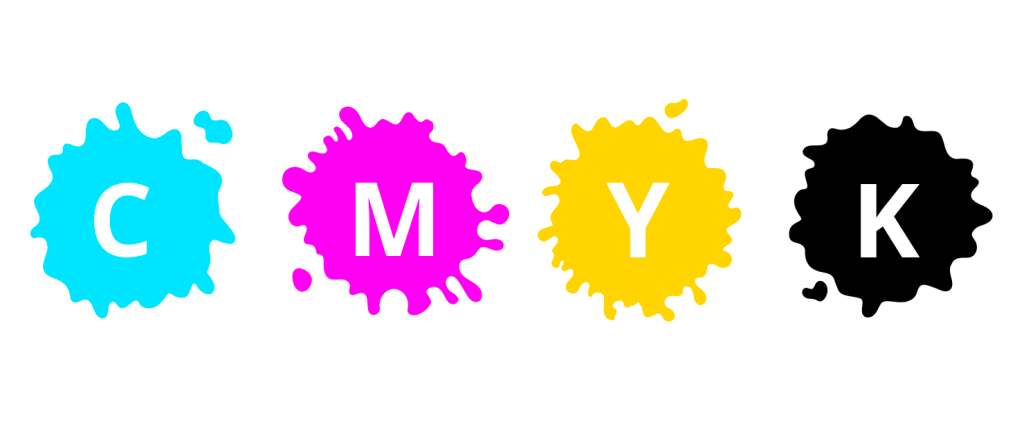
CMYK stands for cyan, magenta, yellow and key (black), and is known as the four-color
printing process. It is distinct from RGB, the other standard color model and is used in a
different way. This article will delve into the basics of CMYK color model printing and
explain how this differs from RGB, and when it would benefit you to use each color
model.
By learning more about CMYK, you can grasp key factors that will enable you to create
print materials with perfectly translated colors across different print media.
What Is CMYK? CMYK, as we mentioned above, stands for the four colors used in printing ink: cyan, magenta, yellow and key (or black). It is a subtractive color model, which refers to the way these colors each reflect or absorb light. In a subtractive color model, colors are created by subtracting certain wavelengths of light. And, when any of these four colors are combined, together they subtract various parts of the light spectrum. The result is the perception of certain colors. In printing, the four colors can be applied to a white surface to produce a very wide range of colors. For example, Cyan absorbs red light, so blue and green light is reflected. This means that when cyan is added to the page, it subtracts red so shades of green and blue are created.
Each of these four colors absorbs and subtracts different colors and thus reflects
different colors. The way these four colors are combined determines each color seen in
a final printed work.
How CMYK in Printing Works
CMYK printing is a unique process that produces excellent color results. To create full-color images, printers use tiny dots of cyan, magenta, yellow, and black inks, carefully overlapping and mixing them to achieve the desired colors. This technique allows for a broader range of hues beyond only the primary colors. During printing, these minuscule dots can be so densely arranged that they can appear as solid colors. By adjusting the quantity and overlap of these dots, printers can reproduce a wide spectrum of colors and that results in high-quality prints. Larger, closely spaced dots create darker areas, while smaller, more spaced-out dots result in lighter shades. By varying dot density and placement, printers can closely match the colors of the original image.
Why Choose CMYK for Printing?
There are some clear advantages in printing with CMYK over printing with RGB, which
stands for Red, Green, Blue. When creating a design for a screen, RGB colors will
always be brighter, as these colors are created for digital images. But for printing,
CMYK can reproduce colors more accurately. By mixing different proportions of the
cyan, magenta, yellow and key (black), a wide enough range of colors is possible to
give superior results.
CMYK is also known for consistency in printing. Even if you need to print multiple runs,
the finished product will turn out uniform. This is helpful for projects like printing
branding or marketing materials, where consistency is essential.
All these reasons have helped make CMYK the industry standard for color printing. And,
since it’s so widely used, most commercial and professional printers are accustomed to
working with CMYK color models.